
Louisiana's Unified Clerk Structure
Louisiana Constitution article V, section 28 establishes the ordinary parish model. Voters in each parish elect a clerk of district court for a four-year term. The clerk appoints deputies and, with judicial approval, minute clerks. That elected office is custodian of district court records and is also ex officio notary and recorder of conveyances, mortgages, and other acts. It commonly handles civil, criminal, family, succession, marriage, land, mortgage, election, and court-minute work.
This is a mostly unified system. A person seeking a felony file, civil judgment, divorce, succession, marriage license, or recorded land act can often begin with one parish clerk. The unity does not mean every local case is there. City, parish, justice, mayor's, traffic, family, or juvenile courts may have their own clerks. Orleans also separates major functions among several offices. The event location, filing court, and record series decide custody.
The Louisiana Clerks of Court Association provides the statewide route to elected parish clerks.
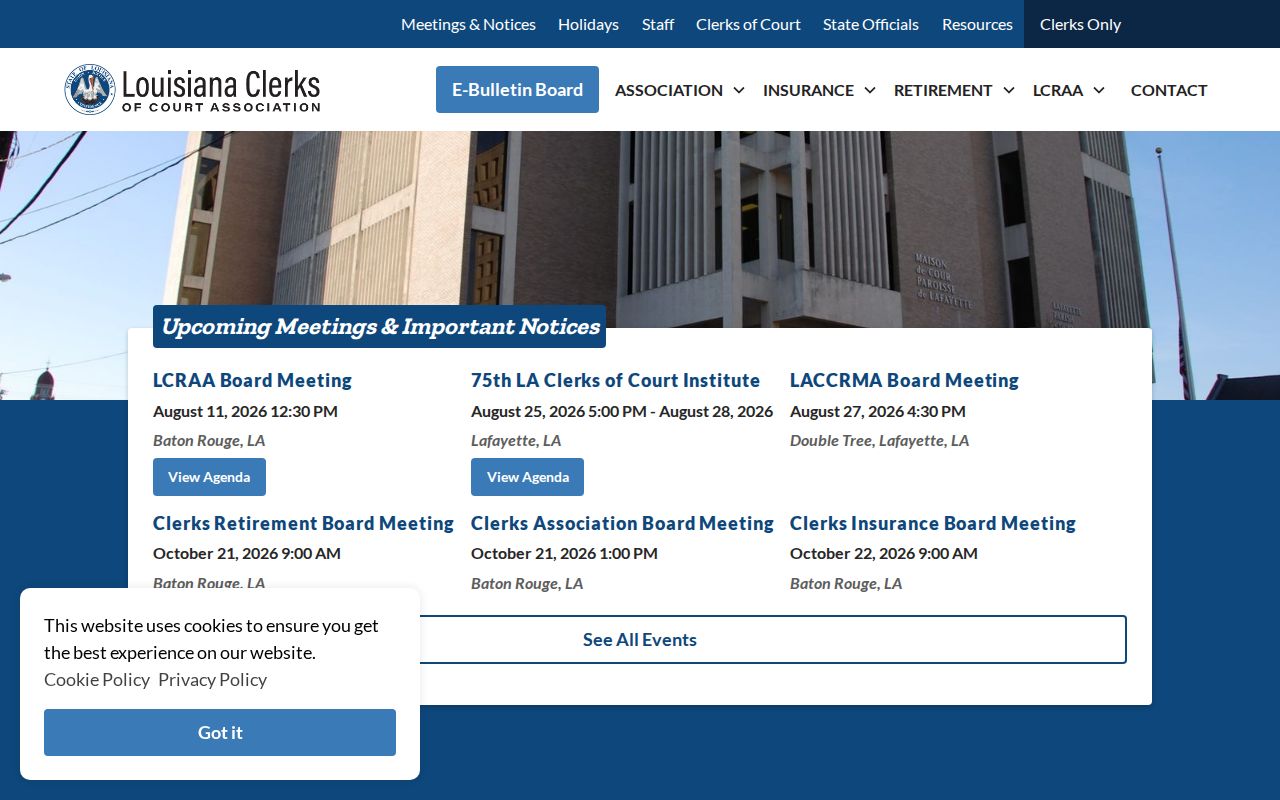
Its directory helps locate the actual custodian when a shared portal does not expose the needed Louisiana clerk record.
Louisiana Clerk of Court Records
A typical Clerk of the District Court accepts filings, assigns suit numbers and divisions, maintains dockets and minutes, issues process, receives fees, stores official documents, and certifies copies. The same office records conveyances, mortgages, marriage licenses, and other acts under its parish-recorder role. It also performs election duties. A single counter may be divided into civil, criminal, family, succession, marriage, conveyance, mortgage, and election departments, so requests should name the record series.
- District civil petitions, service, motions, minutes, judgments, liens, and appeal records.
- Felony charges, pleas, hearing minutes, dispositions, sentences, and criminal filings.
- Divorce, custody, support, community-property, and protective-order files.
- Succession, testament, tutorship, interdiction, inventory, and judgment-of-possession records.
- Marriage licenses and returns, plus conveyance, mortgage, and other recorded instruments.
- Election qualification, polling, returns, and other constitutional election functions.
Juvenile or adoption files and protected family, medical, financial, and identity data are not made public merely because the clerk has custody. A district clerk also cannot certify a city or traffic record kept by another court. Ask which department owns the docket before paying for a broad search.
Orleans Clerk Office Exceptions
Orleans Parish is the major exception to Louisiana's unified clerk pattern. The Clerk of Civil District Court handles civil, domestic, succession, conveyance, mortgage, and related records. The Clerk of Criminal District Court keeps felony prosecution files. Separate clerks or record offices serve First and Second City Courts, Municipal Court, Traffic Court, and Juvenile Court. A request must go to the court that actually opened the case.
Marriage custody also differs. Louisiana Vital Records handles Orleans marriage licensing and retains recent Orleans marriage certificates, while clerks in other parishes issue and record local licenses. An Orleans divorce decree still comes from the court clerk, not the state vital-records office. These are local exceptions, not evidence that Louisiana uses two statewide clerk types.
Note: Never route an Orleans traffic, misdemeanor, criminal, marriage, or juvenile request automatically to the Civil District Court clerk.
Louisiana Clerk Records and Duties
The ordinary parish clerk holds a broad portfolio. Orleans and separate lower courts require a narrower route. The table distinguishes the statewide norm from the qualifications most likely to redirect a request.
| Record or Duty | Typical Parish Clerk | Qualification |
|---|---|---|
| Felony criminal cases | District clerk | Orleans Criminal District Court clerk |
| Civil and family cases | District clerk | Orleans Civil District Court; East Baton Rouge Family Court for assigned matters |
| Misdemeanor and traffic cases | District clerk if filed there | City, parish, municipal, traffic, or mayor's court may keep the file |
| Succession, tutorship, interdiction | District clerk's succession department | Orleans Civil District Court |
| Juvenile and adoption | District clerk unless a separate court exists | Special juvenile courts in designated parishes; access is restricted |
| Marriage license and return | Parish district clerk | Louisiana Vital Records handles Orleans licensing and recent certificates |
| Conveyance and mortgage | District clerk as parish recorder | Orleans Civil District Court land records functions |
| Appeal record assembly | Clerk of the court whose judgment is appealed | Appellate clerk receives the lodged record; trial originals remain local |
Louisiana Court Clerk Duties
The Louisiana Constitution's clerk provision sets the elected office, term, and combined roles. Clerks do more than store papers. They accept pleadings, establish the filing timestamp, assign case numbers, maintain the official docket, record courtroom minutes, issue citations and process, collect authorized costs, safeguard exhibits, prepare appeal records, and provide plain or certified copies. As custodian, a clerk also applies sealing, redaction, juvenile, adoption, and privacy rules.
- Accept filings, date them, and assign suit numbers and divisions.
- Maintain the docket, minute book, official file, and available document images.
- Issue citations, summonses, subpoenas, writs, notices, and certified process.
- Collect and account for filing, service, copy, certification, and court costs.
- Prepare pleadings, minutes, exhibits, transcripts, and judgments for an appeal record.
- Record conveyances and mortgages and perform marriage and election duties in the ordinary parish model.
Clerks cannot provide legal advice or create a record that does not exist. A Louisiana Public Records Law request can seek an identifiable, nonconfidential record, but it does not compel research, analysis, or disclosure of sealed material. For an access denial, ask for the legal basis and custodian's name or title.
Request Louisiana Certified Copies
A certification authenticates a document as a copy from the clerk's official record. Courts, agencies, licensing bodies, title examiners, and other recipients may require it. A portal printout is not automatically certified. Ask the receiving party whether it needs a plain copy, certified copy, exemplified or authenticated copy, complete docket, signed judgment, sentencing minute, or another exact item before ordering.
- Identify the filing parish and exact court. Use the parish directory, and apply the Orleans or lower-court exception if needed.
- Gather the suit number, full caption, year, division, and exact document title and date.
- Ask the clerk about in-person, mail, email, fax, or official portal service and accepted payment.
- Request a written cost estimate, state the certification type, and authorize a maximum charge.
- Check the seal or certification on receipt and compare names, number, court, and document date.
Name-only requests can produce false matches and require more staff time. If the file is old, ask about archives, microfilm, off-site storage, and retrieval time. For a large file, ordering only the docket, signed judgment, and relevant minute may be more useful than paying for every page.
Louisiana Clerk Request Fields
Parish methods vary, but a clear request contains the same core facts. State the existing record rather than asking the clerk to investigate or answer a legal question. Include spelling variants and an approximate range when the suit number is unknown.
| Field | Required | Notes |
|---|---|---|
| Parish and Court | Yes | Identify district, city, parish, family, juvenile, municipal, traffic, or other court. |
| Suit or Case Number | If known | The fastest and safest identifier; retain punctuation and division suffix. |
| Party Names | Yes | Provide the full caption and aliases or spelling variants when possible. |
| Year or Date Range | Yes | Narrows a name search and helps locate archived files. |
| Document Requested | Yes | Name the docket, judgment, minute, pleading, charge, sentence, or instrument. |
| Copy and Certification | Yes | State quantity and whether plain, certified, or authenticated form is needed. |
| Requester and Delivery | Yes | Include name, address, phone, email, preferred delivery, and maximum cost. |
Louisiana Clerk Record Fees
Louisiana R.S. 13:841 provides maximum components for defined civil clerk services. It does not create one statewide all-inclusive price. A parish advance deposit can include service, court reporter, judicial expense, technology, sheriff, retirement, and local or subject-specific charges. Remote images can carry subscription or transaction costs. Copy certification, archive retrieval, media, card use, and postage may add charges, so obtain a current local estimate.
| Item | Amount |
|---|---|
| Civil initialization component | Up to $20 |
| Filed document, first page | Up to $6 |
| Filed document, each later page | Up to $4 |
| Ordinary-size exhibit page | Up to $2 |
| Oversize or other exhibit page | Up to $5 |
| Marriage-license clerk component | $15 |
| Marriage copy component | $5 |
| LCRAA access and images | Subscription or transaction dependent |
Louisiana Clerk Forms
Forms depend on case type and local rules. The official Louisiana Supreme Court rules provide statewide rules and uniform materials, while each parish clerk may publish civil, criminal, family, succession, conveyance, marriage, or election forms. Use the local version when a court requires one. A form does not establish eligibility or replace legal advice.
- Case-type cover or filing sheets identify parties, counsel, service, and classification.
- Uniform expungement motions and orders identify the arrest, charges, disposition, and recipient agencies.
- Pauper affidavits provide income, assets, dependents, expenses, and supporting facts for judicial review.
- Marriage-license applications and record requests collect identity, event, copy, and delivery details.
The parish site reached through the directory is the best source for a current local form, fee sheet, and filing instruction.
Louisiana LCRAA and E-Filing
R.S. 13:754 created LCRAA and required every district clerk to facilitate electronic filing, recording, and remote access through the universal interface by January 1, 2026. The Louisiana Clerks Portal can expose civil, criminal, party, suit-number, recording, conveyance, mortgage, or marriage modules depending on the parish product. Participation does not guarantee free access to every historical image. Accounts, subscription levels, local digitization dates, and transaction charges still differ.
The official Louisiana clerk provision shows the constitutional foundation for the office.
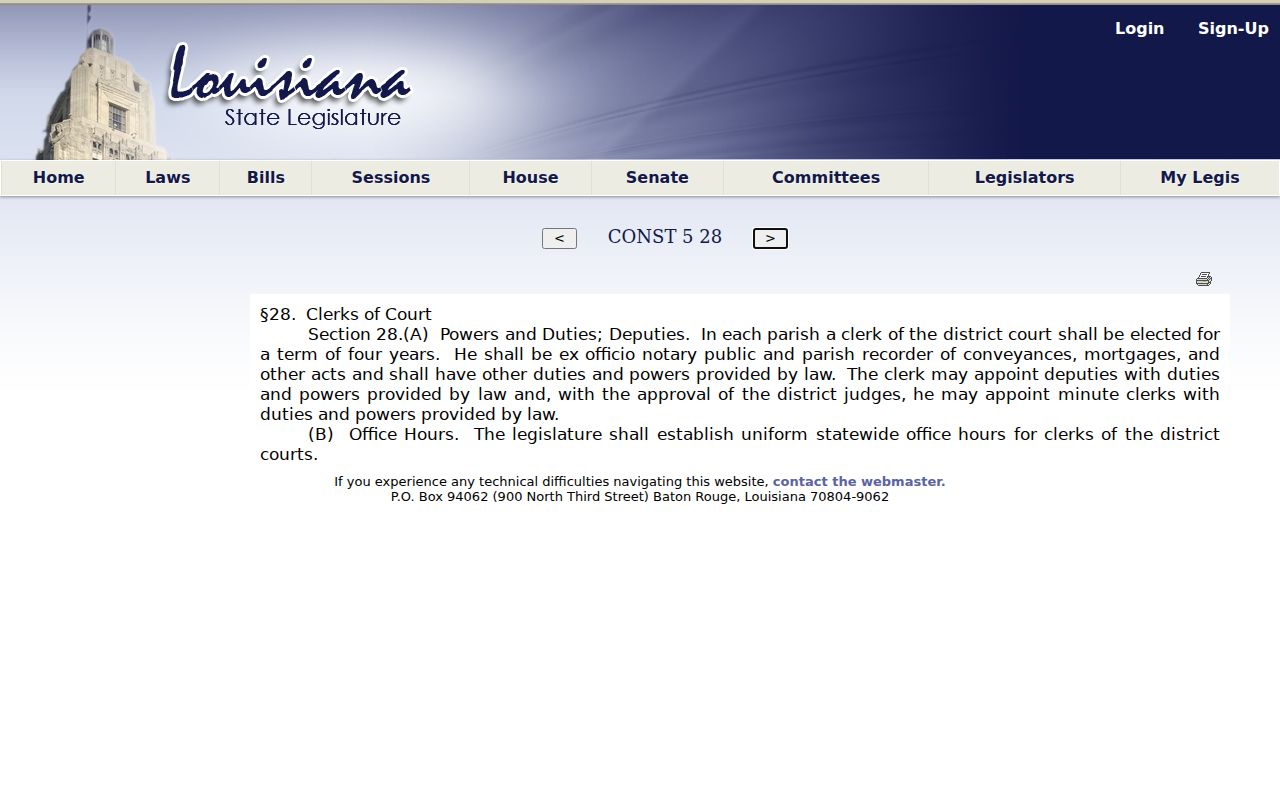
The constitutional role explains why the Louisiana parish clerk combines court custody, recording, notarial, and election duties.
Code of Civil Procedure article 253 recognizes an accepted electronic filing as official and uses its confirmation time as the filing time. It preserves original wills, authentic instruments, notes, defined evidence, and other documents whose originals remain necessary. Mail and counter filing rules still depend on the clerk and case. Check the specific parish before sending originals or payment.
Find Any Louisiana Parish Clerk
Louisiana has 64 parishes, not counties. Browse the full Louisiana parish directory to reach the court and clerk resources for the filing location. Confirm whether the ordinary district clerk, a city or parish court clerk, a special family or juvenile clerk, or one of the Orleans offices holds the record. Shared judicial districts do not merge parish dockets, so always direct the request to the parish where the case or instrument was filed.
Tip: Include the parish, court, suit number, document date, certification type, and cost ceiling to reduce delay in a Louisiana clerk request.