
How to Search Louisiana Court Records
Louisiana has no free judiciary search that contains every district, city, parish, mayor's, municipal, traffic, family, and juvenile case. The Louisiana Clerks' Remote Access Authority portal, or LCRAA, supplies a shared interface for participating clerk indices, document images, e-recording, and e-filing. Every district clerk participates in the statewide infrastructure, but each parish controls its source data. Available years, record series, image depth, subscriptions, and transaction charges vary. The Supreme Court's CMIS receives lower-court data for administration and reporting, but it is not a public statewide name-search service.
Start with the parish where the lawsuit was filed, offense was prosecuted, divorce was granted, or succession was opened. Then identify the court level. A suit number is the best key. When it is unknown, use full names, spelling variants, an approximate year, and a case category. Check the caption, division, and filing date before accepting a match. A person with a common name may have several unrelated results, and a missing index hit may reflect an old paper file, a sealed matter, or a separate lower court.
- Open LCRAA or the official parish clerk portal and choose the filing parish and record series.
- Search the exact suit number. If needed, search surname or business name and narrow by first name, year, and case type.
- Confirm the court, division, parties, and dates. An index entry proves a filing exists, not liability or guilt.
- Open docket events and available images. For a gap, ask the proper clerk about archives, microfilm, or off-site storage.
- Order a plain copy for reading or a certified copy for an official use. Specify the exact judgment, pleading, minute, or order.
The Louisiana Clerks of Court Association directory is another official route to the local custodian. City, parish, mayor's, municipal, traffic, family, and juvenile matters may require a court clerk other than the district clerk. Never assume that one portal covers every Louisiana court record.
Louisiana Court Record Search Fields
LCRAA modules differ by parish and product, so the controls below describe the common statewide interface rather than a promise of identical access. Civil or criminal case searches use different keys from conveyance, mortgage, marriage, or recording searches. Account access or a CAPTCHA may appear before queries or images. Preserve punctuation and any division suffix in a suit number.
| Field Label | Type | Required | Notes / Format |
|---|---|---|---|
| Parish | Dropdown | Yes | Choose the filing parish, not merely the judicial district. |
| Search Type | Tabs or dropdown | Yes | Options may include case, party, suit number, instrument, conveyance, mortgage, or marriage. |
| Last or Business Name | Text | Conditional | Exact and partial-name rules vary; begin with the surname. |
| First and Middle Name | Text | No | Use these fields to reduce false matches. |
| Suit or Case Number | Text | Conditional | Retain the format shown by the clerk. |
| Date Range | Date | No | May filter filing, recording, or event dates. |
| Case Type | Dropdown | No | Parish-defined categories may include civil, criminal, family, and succession. |
Types of Louisiana Court Records
District courts create the main Louisiana records for felony prosecutions, large civil disputes, divorces, custody, and successions. City and parish courts handle many misdemeanors, traffic matters, evictions, and civil claims within limits set for each court. Justice of the peace courts hear small claims and evictions within their authority. Separate family or juvenile courts operate in a few parishes, and Orleans uses distinct civil, criminal, municipal, and traffic courts. The filing court, not the subject's home address, identifies the custodian.
Each category has its own file. A civil record may contain a petition, service returns, exceptions, motions, minutes, and judgment. A criminal file may hold a bill of information or indictment, pleas, hearing minutes, disposition, and sentence. Family files can include a public docket and judgment while financial, child, abuse, and evaluation material is restricted. A Louisiana estate case is called a succession and belongs in district court, not a separate statewide probate court.
- Civil: contracts, torts, property, injunctions, foreclosure, and administrative review.
- Criminal: filed charges, motions, pleas, verdicts, dispositions, sentences, and appeal activity.
- Family: divorce, custody, support, paternity, community property, and protective orders.
- Succession: testaments, estate administration, inventories, creditor filings, and judgments of possession.
- Limited court: traffic, ordinances, misdemeanors, evictions, and small civil demands.
- Appellate: records lodged from trial court, briefs, writ applications, opinions, judgments, and mandates.
The official Louisiana Public Records Law contents show the access framework that applies alongside court rules and specific confidentiality laws.
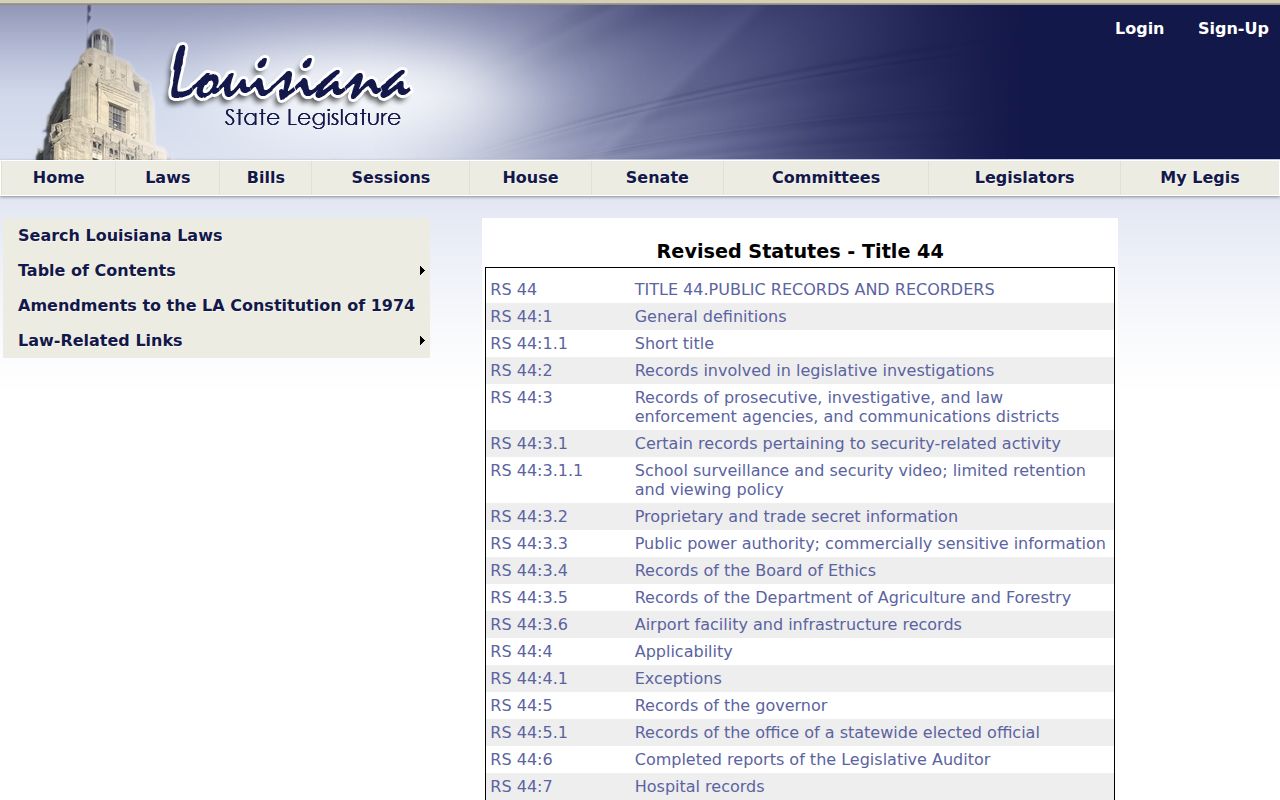
The statute index is useful for checking the current text and exceptions before sending a records request to a Louisiana custodian.
What Louisiana Court Records Show
A Louisiana case result usually identifies the court, parish, judicial district, suit number, division, caption, type, filing date, status, judge, parties, and lawyers. Event detail can add service, hearings, minutes, rulings, judgment, disposition, sentence, costs, appeal number, and image availability. A one-word status needs context. “Closed” may mean judgment, dismissal, plea, acquittal, transfer, consolidation, or administrative closure. Read the last events and signed judgment rather than inferring an outcome from the status line alone.
| Field | What It Shows |
|---|---|
| Suit or Case Number | The clerk's local identifier; keep zeros, hyphens, spaces, and division letters. |
| Caption and Parties | Names and roles, such as plaintiff, defendant, petitioner, or respondent. |
| Filed Date and Type | When the matter opened and its clerk-assigned category. |
| Division and Judge | The section or courtroom allotment responsible for the case. |
| Docket Event | Date, description, filing party, service, hearing, minute, or linked image. |
| Status and Disposition | Current posture and the recorded outcome, which must be read with final orders. |
| Judgment or Sentence | The signed civil relief or criminal penalty, conditions, and financial terms. |
| Appeal Data | Appellate number, lodging events, ruling, and mandate when present. |
For the legal definition of public records, the official text of Louisiana R.S. 44:1 is the primary source.
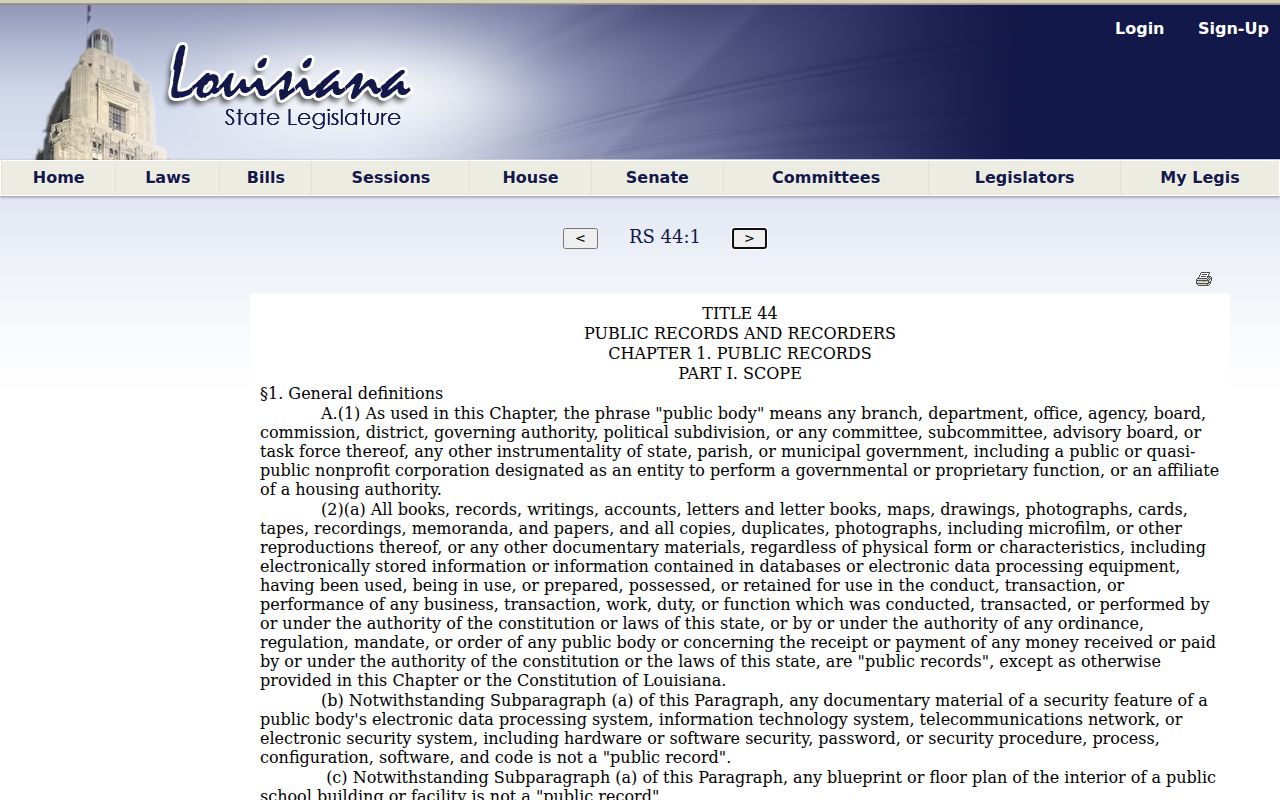
The definition is broad, but it remains subject to court orders, privacy rules, and the exceptions that protect specific records.
Louisiana Court Record Access Law
Louisiana R.S. 44:1 defines public records and custodians. R.S. 44:31 and 44:32 govern inspection, copying, and request mechanics, while R.S. 44:3 protects specified investigative, prosecutive, intelligence, informant, and security material. Open judicial files are often inspected through the clerk's normal service without a formal Title 44 request. When a written request is needed, address it to the office that possesses the record and describe an existing item by names, number, date range, and document type. The law does not require a clerk to answer legal questions or create a custom report.
Code of Civil Procedure article 253 recognizes accepted electronic filings as official records, makes public access track the paper record, and requires omission of protected identifiers. It also preserves original-document treatment for wills, authentic instruments, promissory notes, and other defined evidence. Clerks may charge statutory line items and local costs. R.S. 13:841 lists maxima such as a civil initialization component of up to $20, a first filed page up to $6, and later pages up to $4, but those are not an all-inclusive lawsuit or copy quote.
Note: Ask for a cost estimate and specify plain, certified, exemplified, archived, or electronic copies before authorizing a Louisiana records search.
The Louisiana Attorney General publishes public-records guidance, but it does not hold or certify each parish court file.

Requests still go to the clerk or agency with custody, and a denial should identify the legal basis for withholding or redaction.
Restricted Louisiana Court Records
Juvenile delinquency, child-protection, adoption, treatment, school, and placement records receive strong confidentiality protection. Medical evaluations and competency evidence in mental-health or interdiction cases may also be unavailable even when a limited docket fact or final order is open. Grand-jury material is secret. Presentence reports and many correctional files have special restrictions. Protected addresses, minor identities, financial accounts, full birth dates, and most of certain government identifier numbers must be masked or omitted.
Sealing and expungement are not the same as a case having no result. Louisiana expungement removes eligible arrest and conviction information from ordinary public access without destroying it, and authorized agencies retain statutory access. A person files in the court holding the record, using the required motion, affidavit, order, disposition, and agency details. Eligibility turns on the offense, outcome, sentence completion, prior record, waiting period, and exclusions. A portal gap alone does not prove an expungement.
- Disposition
- The recorded outcome of a claim, charge, or case.
- Sealed
- Access restricted by statute or court order, with scope set by that authority.
- Expunged
- Removed from public access but retained for entities that Louisiana law authorizes.
- Nolle prosequi
- A prosecutor's decision not to proceed with a charge at that time, not an acquittal.
Find Louisiana Court Record Offices
Louisiana uses parishes rather than counties. Each of the 64 parishes keeps a separate clerk, suit-number sequence, docket, and courthouse record even when several parishes share judges in one judicial district. Open the parish directory and choose the place where the case was filed. Then confirm whether the matter belongs to district court or to a city, parish, family, juvenile, municipal, traffic, justice, or mayor's court. The statewide Louisiana clerks overview explains the usual clerk duties and the special split among Orleans record offices.
For older records, ask about archive retrieval, microfilm, an off-site file, or a retention schedule. Include the case number, parties, year, document title, certification need, delivery method, and a maximum cost authorization. A broad request for “the whole file” may be costly and can miss the one signed judgment or minute needed for an official purpose.
Tip: Search the filing parish and court level before using a name; Louisiana records do not merge when parishes share a judicial district.