
What Louisiana Court Dockets Are
A docket is the clerk's chronological index of activity in one case. Each line normally pairs a date with an event, such as a petition filed, service issued, motion received, hearing set, minute entered, order signed, judgment rendered, or appeal lodged. The full record contains the underlying petition, motion, exhibit, transcript, signed order, or judgment. A short docket text may summarize a document but does not replace it. Image links may require an account or charge, and a downloaded image is not automatically a certified copy.
Louisiana dockets differ by court. District clerks maintain felony, major civil, family, and succession dockets. City and parish courts may keep misdemeanor, DWI, eviction, traffic, and small civil entries. Justice of the peace, mayor's, municipal, traffic, family, and juvenile courts can use separate systems. Every parish keeps its own docket even when it shares district judges with nearby parishes. The Supreme Court and five circuit courts of appeal have their own appellate numbers and filings, apart from the parish trial record.
- Docket
- A dated index of what happened in a case.
- Minute entry
- The clerk's record of courtroom action, appearance, ruling, or setting.
- Signed judgment
- The operative written ruling, which can differ from a brief docket summary.
Search Louisiana Court Dockets Online
The Louisiana Clerks' Remote Access Authority portal provides a shared route to participating clerk indices and documents. It is a universal interface, not a free judiciary database containing every Louisiana docket. Parish source systems, dates, case types, document images, subscriptions, and prices vary. CMIS supports judiciary reporting but is not a public statewide name search. For the official district file, use LCRAA or the clerk's own portal, then contact that clerk when an entry or image is missing.
Prepare the filing parish, court type, suit number, party names, and an approximate date. Search the exact suit number first. A name search may confuse people with the same name, business aliases, or changed spellings. Confirm the caption, court, division, judge, and filing year before opening the event history.
- Identify the filing parish and whether the case is in district court or a lower or special court.
- Open LCRAA, the official clerk portal, or the Louisiana parish directory.
- Search by suit number, or use a name with a date range and case type.
- Read events in date order and open the signed order or judgment when available.
- Ask the clerk for archive retrieval or a certified docket when online coverage is incomplete.
Louisiana Court Docket Fields
A Louisiana docket result often begins with parish, court, suit number, caption, case category, division, filing date, status, judge, and parties. The event list can add the filing party, service return, hearing time, minute text, disposition, sentence, financial balance, and document availability. Labels are local. Preserve leading zeros, punctuation, and a division suffix because Louisiana does not use one case-number format across all courts.
| Field | What It Shows |
|---|---|
| Entry Date | The date the clerk accepted or recorded the filing, action, or courtroom event. |
| Event Description | A short label such as Petition Filed, Service Returned, Hearing Set, Continued, or Judgment Signed. |
| Filing Party | The party, lawyer, court, or agency associated with the event. |
| Service or Return | Issuance and delivery status for citation, subpoena, or other process. |
| Minute Entry | A summary of appearances, pleas, evidence, rulings, settings, or sentence in court. |
| Document Link | An available image or purchase control; visibility does not make it certified. |
| Disposition | The outcome of a claim, charge, or case, which should be verified against the signed record. |
Common event labels include Motion Filed, Order Signed, Rule to Show Cause, Continued, Notice of Judgment, Appeal Lodged, Writ, Mandate, and Attachment Recalled. “Pending” means unresolved activity remains. “Closed” does not by itself identify whether the case ended by judgment, dismissal, plea, acquittal, transfer, or another event.
Louisiana Courts With Dockets
Online availability depends on the level and local system. Trial-court indices may appear through LCRAA or a parish clerk site. Lower-court dockets often remain on a court-specific site or require a call, letter, email, fax, or counter request. Appellate dockets belong to the relevant circuit, while the Supreme Court of Louisiana publishes its own docket resources, opinions, rules, and orders. An appellate search does not replace the full trial record lodged from the parish.
- District court: LCRAA or the parish clerk for civil, felony, family, and succession cases.
- City or parish court: the court's own clerk for misdemeanors, traffic, evictions, and limited civil matters.
- Special court: the separate family, juvenile, municipal, or traffic clerk where that venue exists.
- Court of appeal: the circuit assigned to the trial court's geography.
- Supreme Court: the court's own case number, docket, orders, and opinions.
Minutes and signed judgments are distinct. A minute entry can record an oral ruling or courtroom event before a written judgment is signed. Hearing calendars can also change after an online setting appears. Confirm the current setting with the court, especially when attendance or a deadline depends on it.
Louisiana Docket Versus Case File
The docket helps track progress; the full case file supplies the actual record. Louisiana clerks can expose an index more broadly than images. A docket may show that a motion, answer, judgment, or sentence exists while the document remains behind an account, fee, archive request, or access restriction. Exhibits and transcripts may be stored separately. Certification comes from the clerk, not from a screen capture or ordinary downloaded image.
| Docket | Full Case Record | |
|---|---|---|
| Format | List of entries | Full documents |
| Contents | Dates and short event text | Pleadings, evidence, minutes, orders, judgments, and available transcripts |
| Access | May appear in a clerk index | May require an account, payment, written request, or visit |
| Use | Track posture and locate filings | Read the actual filing and verify the operative result |
| Official copy | Certified docket from the clerk | Certified document or record from the clerk |
Note: A docket label is an index clue, not proof of the document's full terms or a person's guilt, liability, or identity.
Read Louisiana Court Dockets Carefully
Louisiana procedure uses terms that can be unfamiliar. An “exception” challenges a petition, jurisdiction, cause of action, prescription, or another defect. A “rule to show cause” sets a request for a response or hearing. “Nolle prosequi” records a prosecutor's decision not to proceed at that time. “No bill” means a grand jury declined to indict on the matter presented. Neither term is the same as a conviction, and neither should be reduced to a vague “closed” label.
Read from the initiating filing through the latest event. Check whether a judgment was rendered and separately signed, whether notice issued, whether an appeal was lodged, and whether a mandate returned. In a criminal docket, distinguish arrest, filed charge, plea, verdict, dismissal, sentence, and probation. In a civil docket, distinguish a default entry from a signed judgment and a money judgment from later satisfaction. If the display is unclear, request the minute and signed order by exact date.
Louisiana Appellate Court Dockets
Final district-court judgments normally go to one of five geographic courts of appeal. The appellate clerk receives a record compiled by the trial clerk, along with briefs, motions, writ materials, opinions, judgments, rehearing activity, and the mandate. A supervisory writ concerns an interlocutory ruling or extraordinary issue and is not the same docket path as an appeal after final judgment. Most further review in the Supreme Court is discretionary, though the constitution assigns direct review in defined matters.
Search both numbers when tracing the full history. The circuit or Supreme Court docket may show the lower-court number and origin, but the parish clerk remains the source for the complete trial file. Published opinions can be available without charge, while briefs, appendices, sealed filings, or record exhibits may require clerk access.
Federal Dockets in Louisiana
Federal cases use a separate system. Louisiana has Eastern, Middle, and Western U.S. District Courts, with appeals to the Fifth Circuit. Use PACER for the official federal docket. A Louisiana state suit number will not work there, and a federal case will not appear in a parish clerk search. PACER permits searches by court, party, case number, or nationwide index and displays numbered docket entries and linked documents subject to federal access and fee rules.
The official PACER landing page illustrates the federal access route.
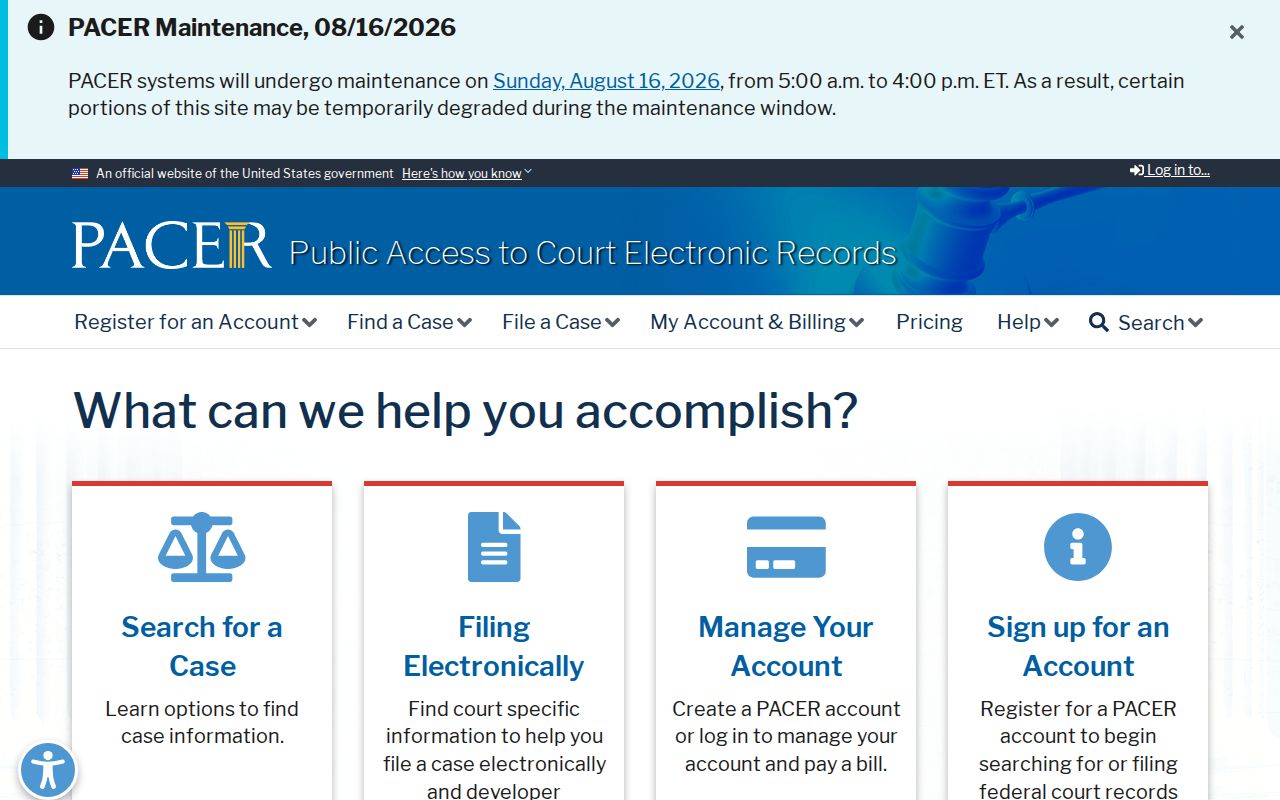
PACER is for federal courts only; opinions may be free, while sealed documents remain unavailable.
The Eastern District of Louisiana maintains its federal court information and filing resources.
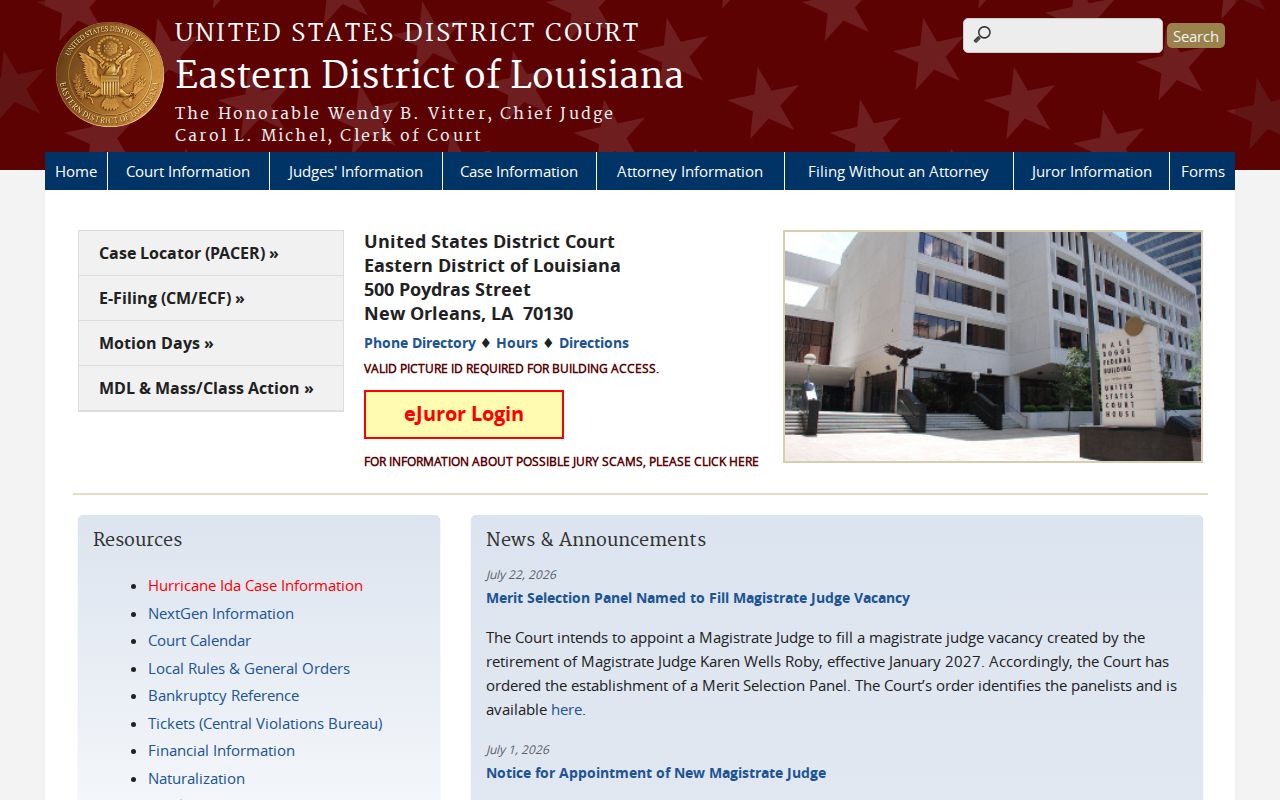
Its cases cover the southeastern federal venue assigned by law, not every Louisiana state proceeding.
The Western District of Louisiana serves federal divisions across western, central, and northern areas.
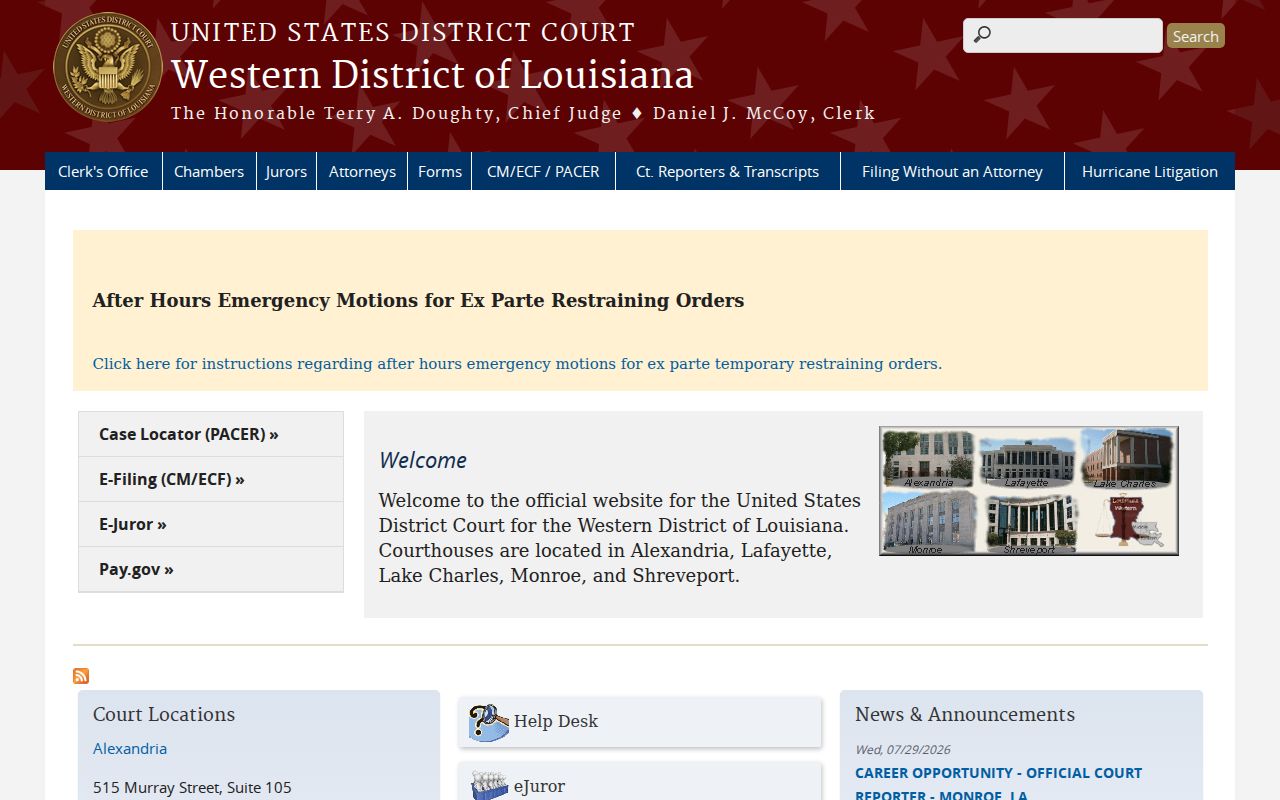
Federal division and district must be verified before searching because venue assignments affect the docket location.
Appeals from all three federal districts go to the U.S. Court of Appeals for the Fifth Circuit.
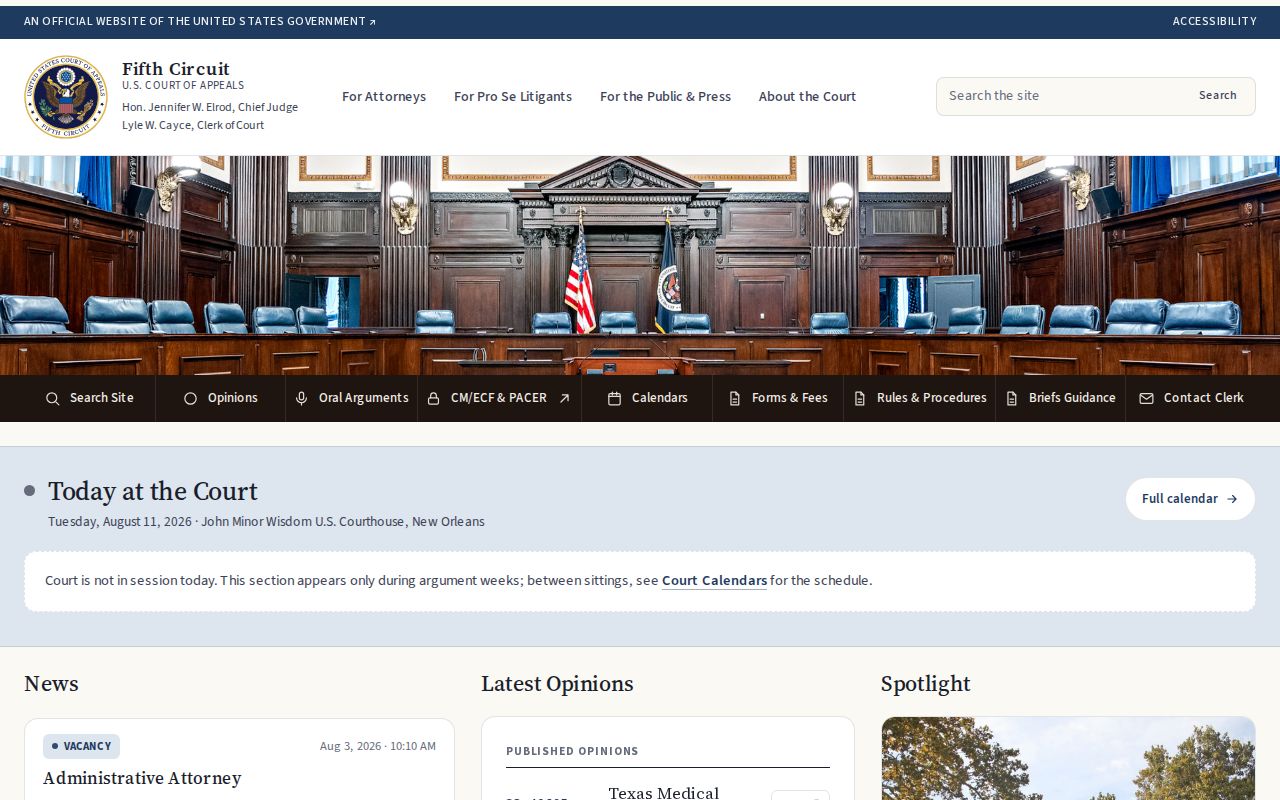
The Fifth Circuit does not review Louisiana state appeals; state cases remain in the state appellate hierarchy unless a separate federal proceeding arises.
Get Louisiana Docket Copies
When a portal lacks an entry, contact the clerk for the exact court and parish. Give the suit number, caption, date range, division, and the requested docket, minute, judgment, or filing. Ask whether the record is online, in paper storage, on microfilm, or off site. For mail or email requests, include requester contact details, delivery method, certification need, and a maximum cost authorization. Clerks may charge for searches, copies, certification, media, postage, and archive work within governing law and local schedules.
Use the directory of all 64 Louisiana parishes to reach the filing location. Orleans civil, criminal, municipal, traffic, and other courts have distinct clerks or record offices. Elsewhere, a city, parish, justice, or mayor's court may also keep a docket apart from the district clerk. A complete search follows the venue, not just the person's residence.
Tip: Request the signed judgment and relevant minute with the docket when the result will be used for a legal or official purpose.