
Who Holds Louisiana Marriage Records
Outside Orleans Parish, the elected parish clerk issues the marriage license, records the officiant's return, and provides certified copies. The Louisiana Department of Health Center for Vital Records and Statistics does not keep all Louisiana marriages. Its marriage-certificate custody is limited to Orleans Parish records within a 50-year retention window. Older Orleans marriage records go to the Louisiana State Archives.
Divorce is a court suit. The District Court clerk, East Baton Rouge Family Court clerk, or Orleans Civil District Court clerk that handled the case supplies the signed divorce decree and court file. LDH cannot issue a certified divorce decree. This difference is central: a marriage license, a recorded marriage certificate, a divorce petition, and a final divorce judgment are four distinct records.
Quick Reference:
Marriage outside Orleans: issuing parish clerk for the original license and recorded certificate.
Recent Orleans marriage: LDH Vital Records for certificates within its 50-year window.
Older Orleans marriage: Louisiana State Archives.
Divorce anywhere in Louisiana: clerk of the parish court that granted the divorce, never LDH.
| Record | Custodian | Best Request |
|---|---|---|
| Non-Orleans license or certificate | Issuing parish clerk | Recorded return or clerk-certified copy |
| Recent Orleans certificate | LDH Vital Records | Certified Orleans marriage certificate |
| Orleans record older than 50 years | Louisiana State Archives | Historical index or archival record |
| Divorce petition, minutes, or decree | Clerk of granting parish court | Certified signed judgment for proof |
Apply for a Louisiana Marriage License
Applicants choose a parish clerk and review that office's current checklist. They should expect government photo identification, Social Security numbers or the statutory alternative, certified birth records, parental details, and information about prior marriages. Certified divorce or death proof may be required when a prior marriage ended. Special consent and judicial rules apply to applicants under the permitted age.
Louisiana generally requires a 24-hour wait between issuance and ceremony, although an authorized official may waive it for good cause. Confirm the license expiration period with the issuing clerk. A qualified officiant conducts the ceremony, completes the certificate with the witnesses, and returns it for recording. A license that was issued but never returned does not by itself prove a completed marriage.
Louisiana Marriage Application Steps
State law and local office procedure work together. Confirm the parish's accepted documents, payment forms, and appearance rules before traveling. Orleans applicants should use the separate LDH process.
- Select a parish and read its official clerk checklist.
- Gather photo IDs, certified birth records, Social Security information, and any required prior-marriage proof.
- Appear as the office requires and provide application data under oath.
- Choose a regular or covenant marriage and submit any added declaration or counseling papers.
- Pay the parish total and observe the waiting period unless a valid waiver is granted.
- Complete the ceremony before expiration, then ensure the officiant and witnesses complete the return.
- Verify that the issuing office recorded the return before ordering certified copies.
Louisiana Marriage Form Fields
The Orleans application inventory shows the detailed identity and vital-statistics data an office may request. Protected fields are collected for legal and statistical use, not for open web display. Parish forms can differ, so use the current form from the chosen clerk.
| Field Group | When Required | Details |
|---|---|---|
| Identity and residence | Each applicant | Legal and prior names, address, date and place of birth, age, and sex |
| Protected identity | Each applicant or statutory statement | Social Security number; not for public display |
| Parents | As form directs | Parent names, maiden names, and birthplaces |
| Prior marriages | Each applicant | Number and last marriage's end date and manner, with proof if required |
| Legal declarations | At application | Relationship, eligibility, signatures, oath, and optional covenant-marriage papers |
| Ceremony return | After issuance | Date, place, officiant identity, witnesses, and signatures |
Louisiana Marriage and Divorce Fees
Do not build a parish total by adding statutory components. Local and state items differ. Ask the parish clerk for the current full license or divorce advance deposit. The LDH fee schedule supplies the Orleans Vital Records amounts. Vital Records states that its statutory fees are not waivable.
| Item | Current Researched Amount | Qualification |
|---|---|---|
| Parish marriage license | Current parish total | Includes local and statutory charges; confirm with clerk |
| Orleans marriage license through LDH | $27.50 | Plus $5 for each desired certified certificate |
| Orleans marriage certificate | $5 | Mail adds a $0.50 state charge; vendor, security, or shipping fees may apply |
| Divorce filing | Parish advance deposit | Service and requested relief affect the total |
| Certified divorce judgment | Current clerk quote | Page, certification, search, archive, and delivery charges can differ |
The official Louisiana vital-record fee page illustrates how state charges are presented. Its screen also reinforces why an Orleans certificate price should not be copied to every parish.
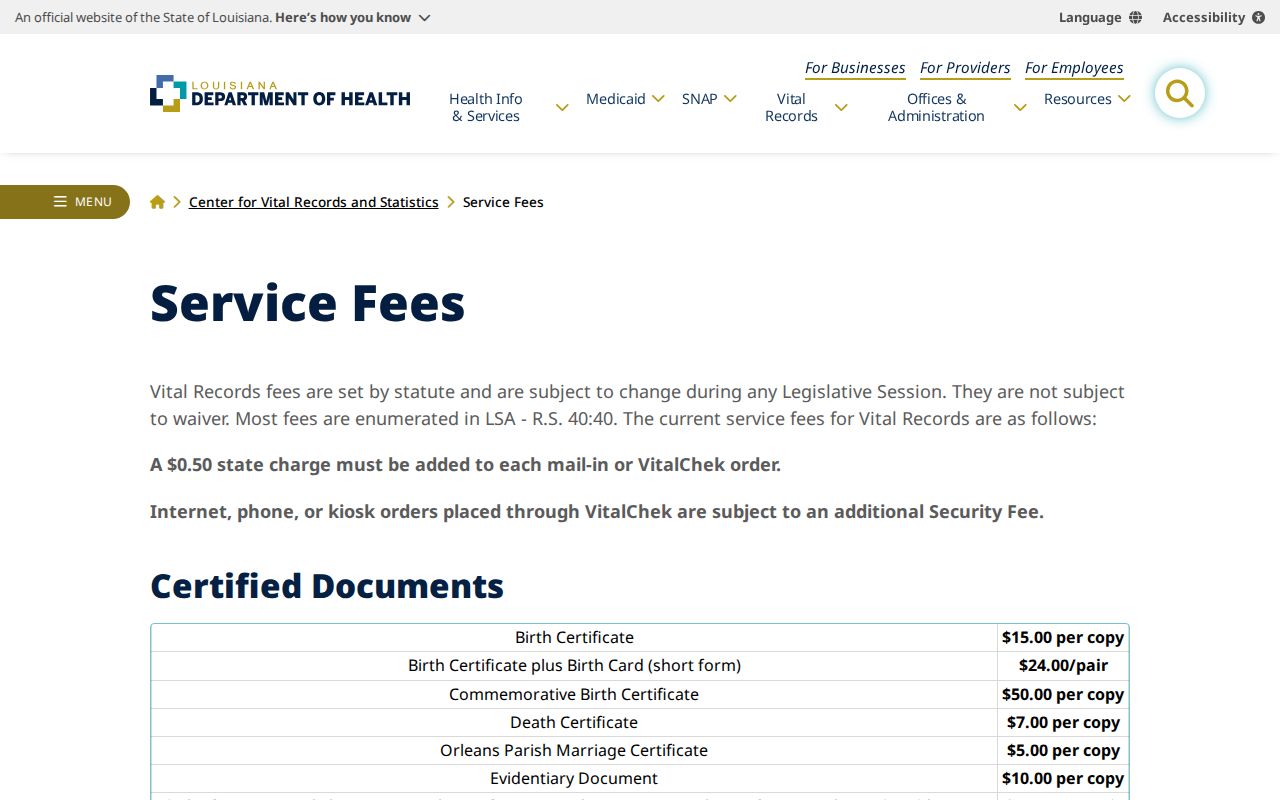
Use the dated agency schedule for LDH orders and a fresh clerk quote for every parish request.
Louisiana Vital Records Exception
The Center for Vital Records and Statistics maintains statewide birth and death records, but its marriage coverage is Orleans-only for 50 years. It accepts eligible Orleans certificate requests in person, by mail, and through its named online ordering partner. The mail or walk-in form asks for both spouses' names, including maiden name, marriage date and place, copies requested, requester identity and relationship, purpose, contact details, signature, and identification.
The LDH marriage-record page shows the split between state and parish custody. That distinction keeps a non-Orleans marriage request from being sent to a state office that does not hold it.
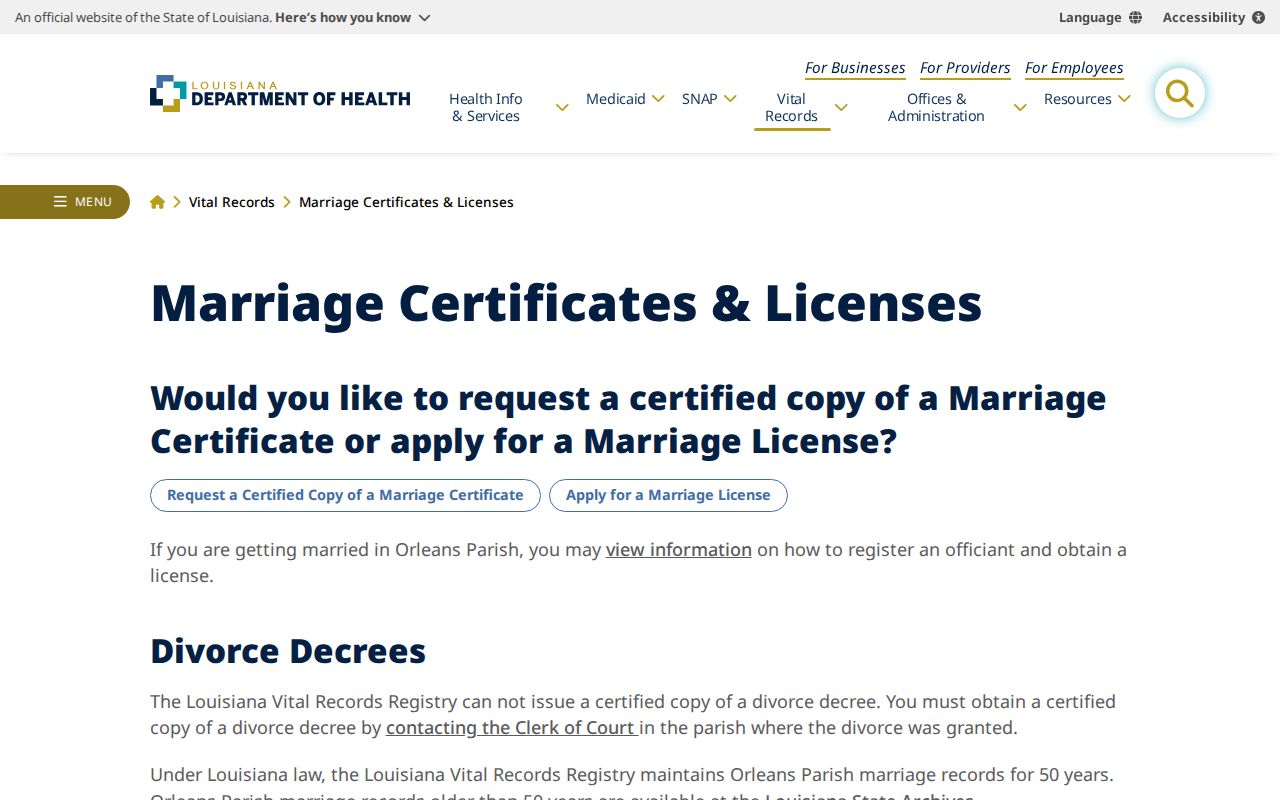
Use LDH for a recent Orleans certificate, the issuing parish clerk elsewhere, and the granting court clerk for every divorce decree.
Louisiana Vital Records Central Office
1450 Poydras Street, Suite 400
New Orleans, LA
Walk-in hours: 8:00 a.m. to 3:30 p.m., excluding holidays
Search Louisiana Divorce Records
Search the civil or family index in the parish where the divorce was filed. Use both spouses' names and an approximate filing year. East Baton Rouge Family Court and Orleans Civil District Court are special routes. Ask the clerk for the petition if relevant, chronological minutes, and the signed certified judgment of divorce. An index hit does not prove that the marriage ended.
Interim custody, support, use of property, protective relief, and community-property issues may continue after marital status ends. Financial records, child information, evaluations, abuse material, and protected addresses may be sealed or redacted. A separation petition or support suit can resemble a divorce caption without containing a final decree. Only the granting court can certify the judgment.
Louisiana Covenant Marriage Records
Louisiana offers a covenant-marriage option with added counseling and declaration documents and more limited grounds or procedures for dissolution. It is not the same as an ordinary marriage license. Applicants selecting it should obtain the current official forms and counseling requirements. Divorce from a covenant marriage follows its own statutory framework and still produces a court file with the proper parish clerk.
The Louisiana covenant-marriage resource presents this distinct election. Its visual record helps explain why the selection appears among marriage application fields.
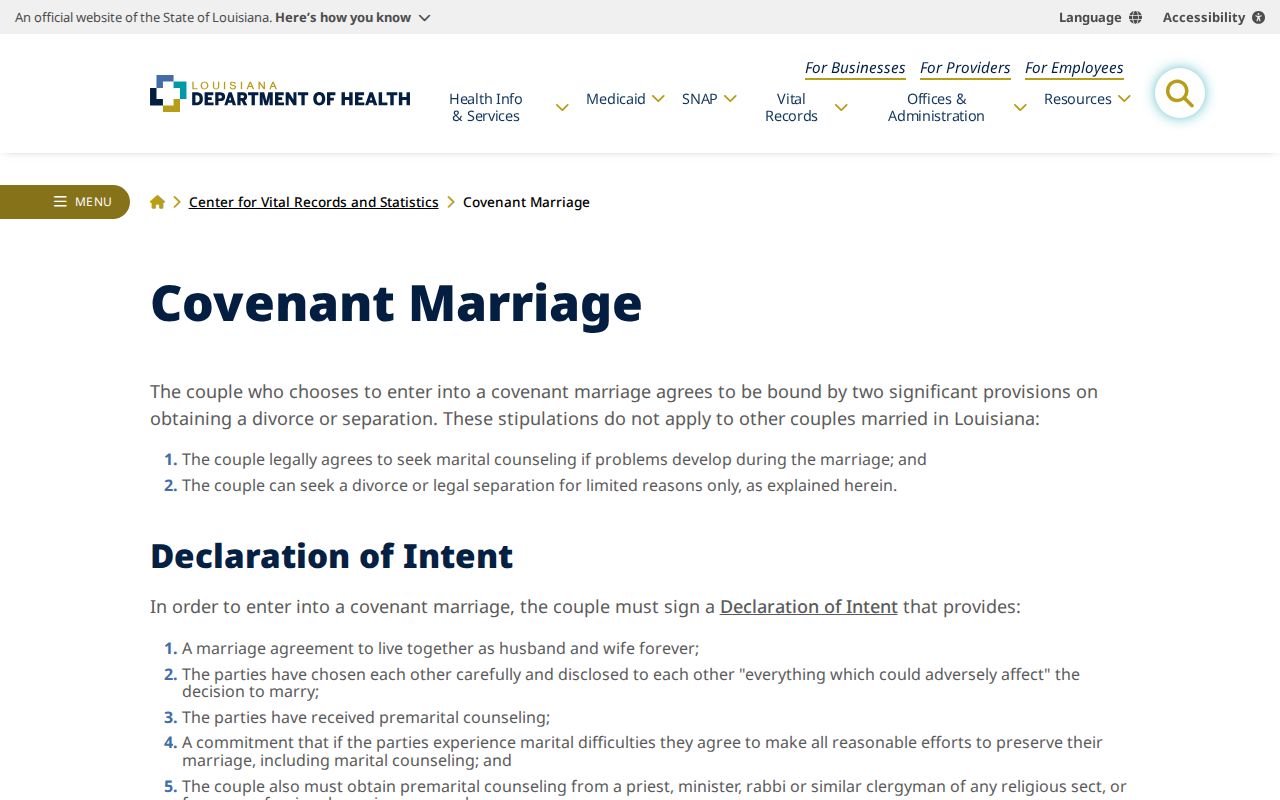
A clerk search should account for the marriage type, but certification still comes from the office that holds the recorded marriage or divorce judgment.
Certify Louisiana Marriage and Divorce Records
First decide what the recipient requires. A recorded marriage certificate proves that the officiant returned the completed record, while an unreturned license only shows authorization. For divorce, a petition shows that relief was requested, but only the signed final judgment and applicable finality rules establish dissolution. Ask the recipient whether it needs a clerk-certified original record, an LDH Orleans certificate, or another form of proof before paying.
For a parish request, provide both parties' full names, maiden or prior names, approximate event date, parish, and any known license or suit number. State whether the request is for a search, plain copy, certified copy, petition, chronological minutes, or final judgment. Ask about identity rules, payment forms, turnaround, archive retrieval, and return-mail requirements. A downloaded index image is not automatically certified.
Genealogy follows the same custody logic. Recent non-Orleans marriage records remain with the issuing parish clerk. Recent Orleans certificates use LDH, and Orleans records beyond the 50-year state retention window go to the State Archives. Historical indexes can lead to an entry, but an index alone may not provide the legal proof needed for a present-day name, estate, or benefit matter.
Find Louisiana Parish Records
Begin with event location, legal venue, and present custodian. For a marriage outside Orleans, contact the clerk that issued the license and recorded the return. For a divorce, contact the clerk of the court that signed the judgment. For a recent Orleans marriage, use LDH. For an older Orleans record, use the State Archives. Browse the directory of all 64 Louisiana parishes to reach the correct local clerk and request method.
Provide exact names, approximate dates, the parish, and the document needed. State whether a plain image or certified copy is required. Older books or microfilm may exist even when an online index has no result. Note: The absence of an LDH marriage record outside Orleans reflects custody limits, not proof that the marriage never occurred.