
Louisiana Criminal Case Files
A criminal court file begins with the formal prosecution, not merely the arrest. The clerk records the bill of information or indictment, suit number, division, defendant, counsel, filed counts, arraignment, plea, motions, minute entries, hearings, trial result, disposition, and sentence. The file can later gain an appeal mandate, probation revocation, habitual-offender proceeding, or expungement order. An arrest agency's booked charge may change before filing, so readers researching the accusation itself should distinguish Louisiana arrest records and court charges from the completed court file.
Louisiana district courts hear felonies and some misdemeanors. Other misdemeanors, ordinance cases, traffic matters, and DWI prosecutions can stay in city, parish, municipal, traffic, or mayor's court. Searching only the district clerk can therefore miss a lower-court case. Each parish clerk keeps its own docket even when judges serve a multi-parish district. The parish, exact court name, and suit number identify the file. Preserve each hyphen, space, leading zero, and division suffix when requesting documents.
Search Louisiana Criminal Court Records
Louisiana has no free judiciary search covering every trial court. The Louisiana Clerks' Remote Access Authority portal provides shared infrastructure for clerk indices, documents, e-filing, and e-recording. Record series, date depth, images, subscriptions, and transaction charges still vary by parish. The authoritative record remains with the clerk. Start from the prosecution parish in the Louisiana parish directory, then check each plausible district or lower court.
- Collect the defendant's full name, aliases, filing year, arrest parish, and any labeled case, booking, or citation number.
- Search the parish clerk or LCRAA index. Booking, CMIS, and court numbers are not interchangeable.
- Check the city, parish, municipal, traffic, or mayor's court for misdemeanors, ordinance charges, citations, and DWI matters.
- Read the newest charge, plea, minute, and disposition for every count.
- Order the charging instrument and certified disposition from the holding clerk when formal proof is needed.
Online access is only one channel. A clerk may offer counter inspection, mail fulfillment, a paid index search, or an electronic copy after a focused request. State CMIS data are used for administration and reporting, not open public name searching. Note: A clerk-certified disposition is stronger proof than a portal result and should name each filed count and its outcome.
Louisiana Criminal Case Stages
After arrest, a judge reviews custody, rights, counsel, and bond. The district attorney screens the report and may accept, refuse, amend, divert, or keep investigating. A bill of information or grand-jury indictment starts the formal case. Arraignment records a plea. Pretrial filings may address discovery, suppression, competency, severance, continuance, or bond. Resolution may be dismissal, nolle prosequi, diversion, accepted plea, bench trial, jury verdict, mistrial, or acquittal. Sentencing minutes may record confinement, hard labor, suspended time, credit, probation, fines, costs, restitution, and concurrent or consecutive terms.
Case flow: Charges Filed › Arraignment › Pretrial / Motions › Plea or Trial › Disposition › Sentencing
Later filings matter. An appeal, writ, mandate, revocation, post-conviction application, or expungement can alter the first closure. Louisiana classifies crimes chiefly through each statute's penalty rather than one universal letter-grade system. Check a portal's felony or misdemeanor shorthand against the statute in force on the offense date.
What Louisiana Criminal Records Show
Louisiana clerk systems use different labels, but the same core facts trace a prosecution. A docket line is an index description and may not reproduce the signed instrument. Images depend on parish and access tier. The safest reading joins the header, filed count, minutes, and final order.
| Field | What It Shows |
|---|---|
| Case identity | Parish, court, district, suit number, division, judge, and filing date. |
| Defendant | Name, aliases, limited identifiers, counsel, prosecutor, and party roles. |
| Filed counts | Count, statute, charge, offense date, and bill or indictment date. |
| Plea and bond | Arraignment, plea by count, bond amount, type, and status. |
| Docket activity | Motions, hearings, minutes, rulings, trial, warrants, and appeal references. |
| Outcome | Disposition per count, sentence, suspended term, probation, fine, costs, and restitution. |
The Legislature's official expungement law explains why a public portal can omit a record still retained by authorized agencies.
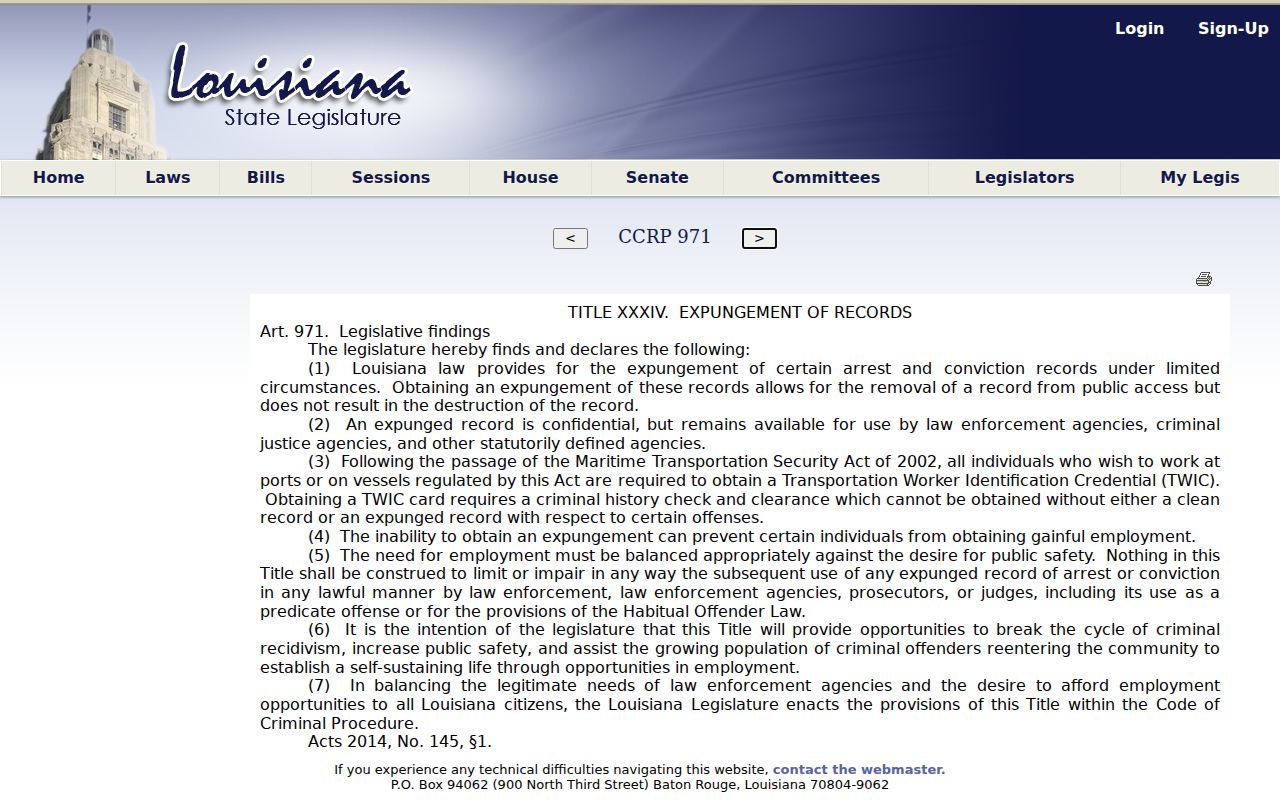
The source defines removal from public access without physical destruction of the Louisiana criminal record.
Louisiana Charges vs Convictions
A charge is an accusation. A conviction follows an accepted guilty plea or a verdict of guilt. Probable cause may support arrest or charging, while proof beyond a reasonable doubt governs guilt at trial. One Louisiana case can contain refused, amended, dismissed, diverted, acquitted, and convicted counts. Report each count separately. Never turn a booking label, bond amount, or pending count into a claim of guilt.
| Charge | Conviction | |
|---|---|---|
| Stage | Accusation | Verdict or plea |
| Burden of Proof | Probable cause | Beyond reasonable doubt |
| Possible result | Refused, amended, dismissed, diverted, or tried | Sentence and later review |
Read Louisiana Case Outcomes
"Open" or "pending" means activity remains, not guilt. "Disposed" or "closed" means an ending event was recorded, which might be dismissal, plea, acquittal, transfer, consolidation, judgment, or administrative closure. "Nolle prosequi" is a prosecutor's formal choice not to proceed at that time. It is not an acquittal. "No bill" means the grand jury declined the accusation. A stayed matter is paused, while an inactive label may be administrative.
Sentence review requires more than reading confinement time. Check for hard labor, a suspended part, credit for time served, concurrent or consecutive terms, and probation. Fines, costs, and restitution are separate. A later habitual-offender adjudication, revocation, or amended sentence may replace an earlier line. Note: Bond secures appearance and compliance; it is neither a fine nor proof that the defendant committed the charged offense.
Louisiana Sealed vs Expunged Records
Sealing restricts access under a statute or order. Louisiana expungement removes covered arrest and conviction information from public access but does not destroy it. Authorized courts and criminal-justice agencies retain access defined by law. Eligibility depends on the charge, disposition, prior history, sentence completion, waiting period, and exclusions. The motion is filed in the court possessing the record, and the clerk gives notice to named agencies.
| Sealed | Expunged | |
|---|---|---|
| Public visibility | Restricted by law or order | Removed from ordinary public access |
| Record existence | Record remains | Record remains and is not destroyed |
| Authorized access | Depends on the order and statute | Named agencies retain statutory access |
The Legislature publishes the Louisiana expungement definitions, including redaction and interim expungement.
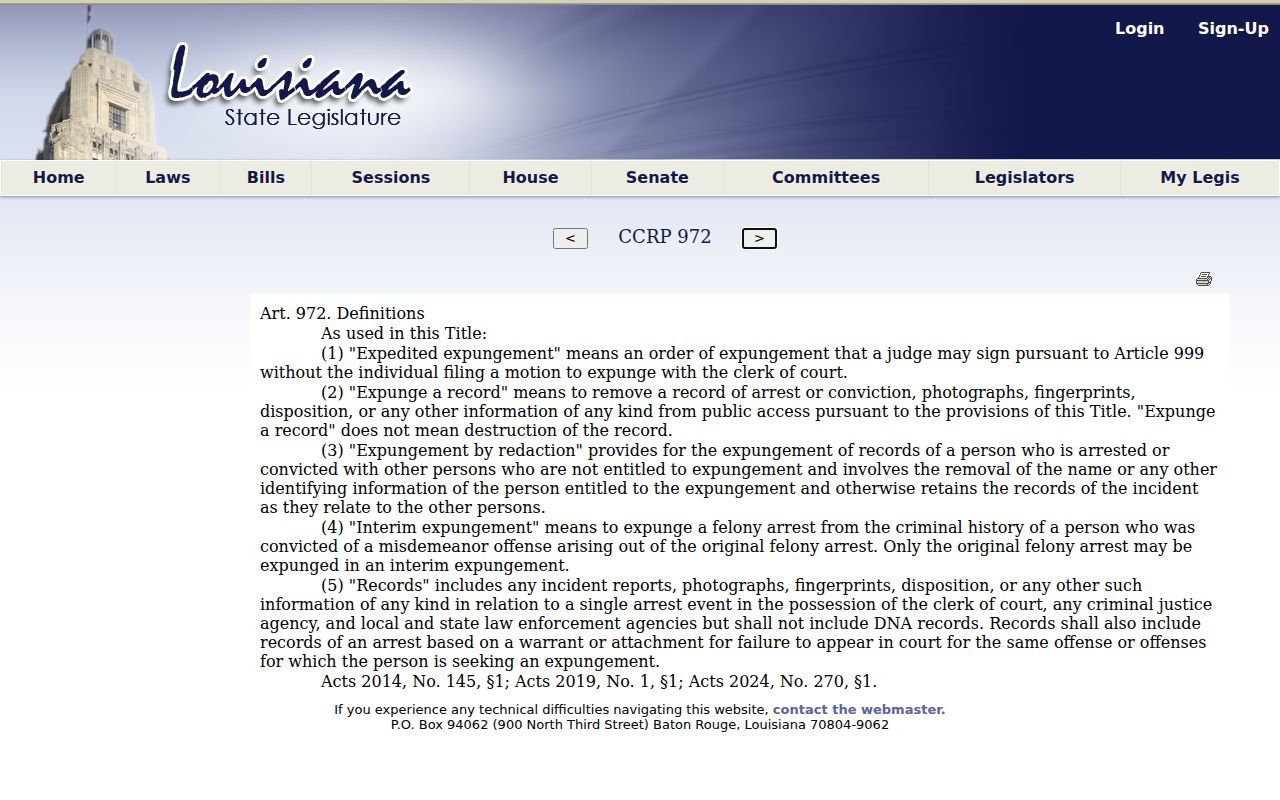
These terms prevent the common error of describing an expunged Louisiana record as erased.
Access Louisiana Criminal Court Records
Open court files can often be inspected through ordinary clerk access. Louisiana Public Records Law also defines public records and provides inspection and copying rights, subject to exceptions. A focused request should name the custodian, defendant, case number, date range, and exact existing document. The law does not require an office to answer legal questions or create a custom report.
Key Louisiana authorities:
R.S. 44:1 defines public records, public bodies, and custodians.
R.S. 44:3 protects specified investigative, prosecutive, intelligence, security, and pending-criminal material.
The official Article 983 fee provision documents ordinary expungement processing charges and exemptions.
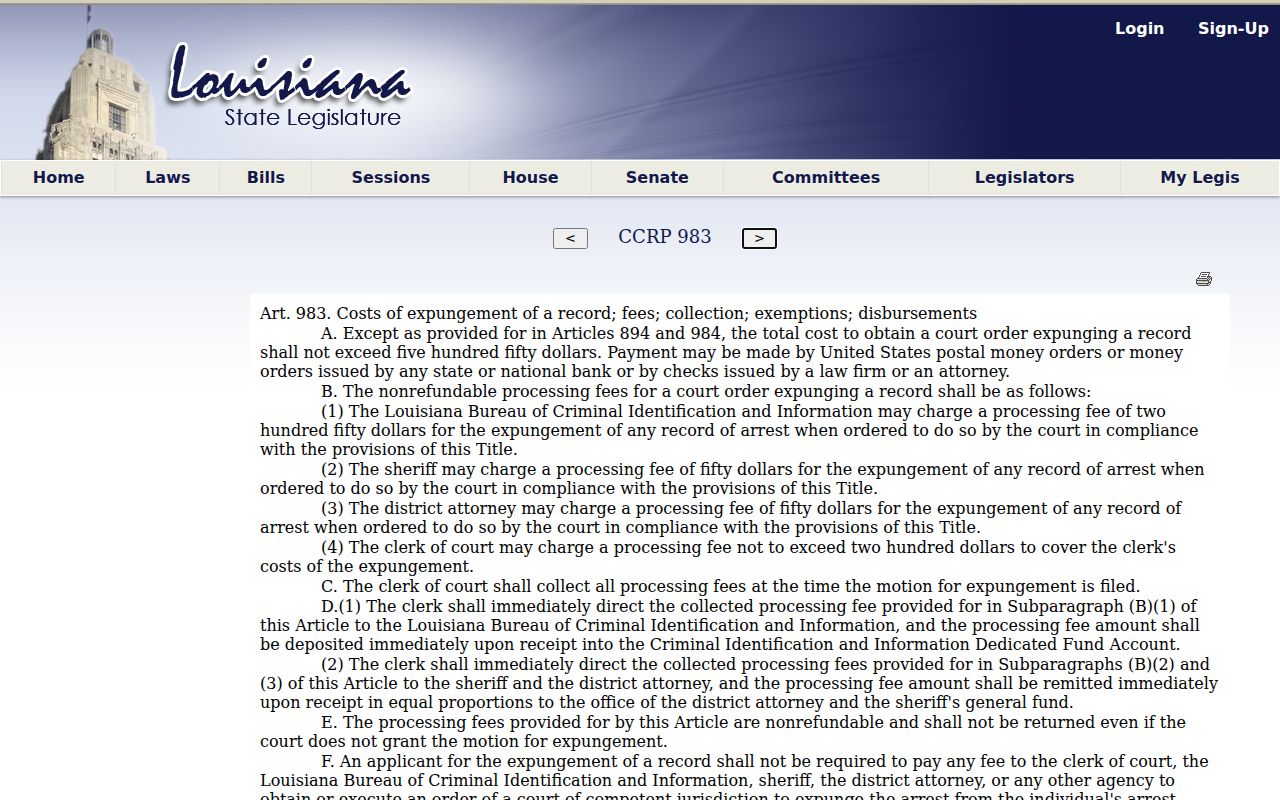
Applicants should use current forms and confirm the actual amount and exemption status with the clerk.
Louisiana State Criminal History
The Louisiana Bureau of Criminal Identification and Information within State Police maintains the fingerprint-linked state repository. Louisiana is a closed-record state. The Internet Background Check serves recipients authorized by law, not unrestricted public name browsing. Its online product is name based, while fingerprints are required when law demands positive identification. A repository response may include arrest, charge, court disposition, and sentence data reported by agencies, but not the complete parish pleadings and minutes.
The official BCII authorization and fingerprint form shows identity, consent, agency, and submission details.
The form shows why an authorized background check is not the same as a Louisiana parish case search.
Name-based results can create false matches or misses. If the state response lacks a disposition or seems wrong, get a certified disposition and use BCII's correction process. Formal consumer reporting also carries duties under the Fair Credit Reporting Act.
Important: Louisiana Court Records is not a consumer reporting agency, and its information may not be used for FCRA-regulated decisions.
Restricted Louisiana Criminal Records
Juvenile files, grand-jury material, presentence reports, sealed or expunged records, medical and competency details, victim information, and protected investigative material may be absent. Filers must mask specified portions of Social Security, tax, state-ID, driver's-license, account, and birth-date data. Discovery held only by counsel may never become a clerk attachment. A public request cannot override a sealing order or R.S. 44:3.
When no case appears, test spelling variants, aliases, venue, lower courts, transfers, and old paper indices before drawing a conclusion. Ask the proper clerk for an index search or certified copy. Louisiana's 64 parish files remain tied to local venue. The parish directory identifies the clerk that can certify the current docket, charging instrument, minutes, and judgment.
Older Louisiana criminal records may survive in minute books even when pleadings are not digitized. Ask whether the index is onsite, archived, or held on microfilm, and give a narrow year span. For a mail request, state the exact caption, court, division, suit number, document, certification need, delivery method, and cost limit. Never send cash unless the clerk expressly directs it. A transcript is a separate verbatim court-reporter product and may require a deposit and preparation time.
Accuracy also depends on count-by-count review. Capture original and amended statutes, plea, verdict, sentence, concurrency, later revocation, and the appellate mandate. Bond follows its own lifecycle of setting, posting, modification, forfeiture, reinstatement, and discharge. Restitution, court costs, and fines use different legal ledgers. Keeping these fields separate prevents a routine docket abbreviation from becoming a false statement about guilt, punishment, or money owed.