
Louisiana Probate Means Succession
Louisiana's estate proceeding is a succession. A testate succession involves a testament, the Louisiana term for a will. An intestate succession follows the rules that apply when no valid testament controls. The District Court may probate the testament, appoint a representative, authorize acts when needed, resolve claims or disputes, and issue the judgment of possession that sends property to successors.
There is no separate Louisiana Probate Court system. The proper parish District Court holds the succession, and Orleans matters go to Civil District Court. The clerk's succession or probate department maintains the suit. Some rural parishes share judges within one judicial district, yet each parish has its own clerk and docket. Searches must follow the parish of the decedent's domicile and, in some cases, the place where Louisiana property is located.
Louisiana venue rule: Search the District Court succession docket, not an invented Probate Court, then check conveyance records when inherited immovable property is involved.
Louisiana Succession Terms Defined
Louisiana civil-law vocabulary carries precise meaning. Replacing it with generic out-of-state labels can misroute a record request or obscure the authority shown by a filed document.
- Testator
- The person who made a testament, which is Louisiana's term for a will.
- Succession representative
- The executor named for a testate estate or administrator appointed for an intestate estate.
- Intestate
- Dying without a valid testament controlling the succession.
- Legatee and heir
- A legatee receives under a testament; an heir succeeds by law.
- Judgment of possession
- The court judgment that identifies successors and sends described property to them.
- Tutorship
- A court-supervised legal relationship that protects a minor and may include an undertutor, bond, inventory, and accounts.
- Interdiction and curatorship
- A proceeding concerning an adult found unable to care for person or property, with a curator appointed under court supervision.
Search Louisiana Succession Records
Louisiana has no complete free statewide succession database. The Louisiana Clerks' Remote Access Authority portal provides shared infrastructure for parish clerks, but searchable series, historical depth, images, subscriptions, and transaction charges differ. A portal miss is inconclusive. Older suits may remain in books, microfilm, or paper files.
Identify the parish before searching. Use the decedent's legal name, maiden name or aliases, approximate death year, domicile, and known property. An exact suit number is best. Ask both the succession department and recorder when a small-succession affidavit or judgment may have been recorded without the expected online succession result.
| Search Field | Use | Louisiana Note |
|---|---|---|
| Decedent last name | Primary name search | Try maiden names and aliases |
| First and middle name | Narrow possible matches | Vary initials and spelling |
| Suit number | Exact alternate search | Use the parish-assigned format |
| Case type | Filter record series | May appear as succession, probate, testament, tutorship, or interdiction |
| Filing date range | Narrow by time | Begin with the death year and later dates |
| Division | Parish-specific filter | Use when the clerk exposes it |
Louisiana Succession Process
The exact path depends on the testament, assets, debts, heirs, and disputes. No one timeline applies. Forced heirship, usufruct, community property, missing heirs, creditor issues, valuation, or litigation can add major work. A simple possession matter may proceed more quickly.
- Locate the original testament and death certificate, then identify domicile and Louisiana property. Do not alter or remove staples from an original testament.
- Determine whether a judicial succession is needed or a small-succession procedure may apply. Verify the current statute and form rather than relying on a stale dollar threshold.
- File the petition and required affidavits in the proper parish District Court, with the testament when applicable.
- The court probates the testament or appoints a representative, and the clerk issues letters. Bond may apply unless law or the testament waives it.
- The representative safeguards property, prepares a sworn detailed descriptive list or inventory, and addresses creditors, taxes, and required notices.
- Seek approval for sales, compromise, borrowing, accounts, or distribution when the administration requires it.
- Obtain a judgment of possession or distribution, then record a certified judgment in conveyance records for immovable property.
Louisiana Succession Administration Types
Independent administration can reduce recurring court approval when Louisiana law, the testament, and the court's authorization allow it. Administered successions involve more judicial supervision. The label does not remove the representative's duty to protect property, address valid claims, keep records, and seek the filings or approval the particular act requires. Docket entries should be read with the actual orders and letters.
A small-succession affidavit can permit transfer without a conventional full succession when current statutory conditions are met. The value threshold and exceptions have changed over time, so a researcher should verify the current law and official form instead of quoting an old limit. The affidavit may appear in parish conveyance records. That is why a search of only the District Court suit index can miss a valid recorded inheritance instrument.
Testate and intestate do not describe the amount of court work. They describe whether a valid testament controls. A testate estate may still face a contest, forced-heirship issue, creditor claim, or hard-to-value property. An intestate estate may proceed without dispute once identity, kinship, debts, and title are established. The file itself shows which path the court authorized.
Louisiana Succession Filing Fees
A succession filing requires a parish advance deposit, not one statewide flat price. Service, publication, court reporter, judicial expense, technology, recordation, and local or subject-specific charges may affect the total. Louisiana R.S. 13:754 supports remote-access infrastructure, but access fees remain product-dependent. Request the clerk's current succession cost sheet.
| Item | Current Rule |
|---|---|
| Succession petition | Parish advance deposit; request the exact current total |
| Civil initialization component | Up to $20 under R.S. 13:841, not the full filing price |
| Filed pages | First page up to $6; later pages up to $4, with separate exhibit components |
| Remote image | LCRAA subscription or transaction charge may apply |
| Plain or certified copy | Ask for search, pages, certification, archive, recordation, postage, and card charges |
The official remote-access statute source shows the statewide infrastructure behind parish record service.
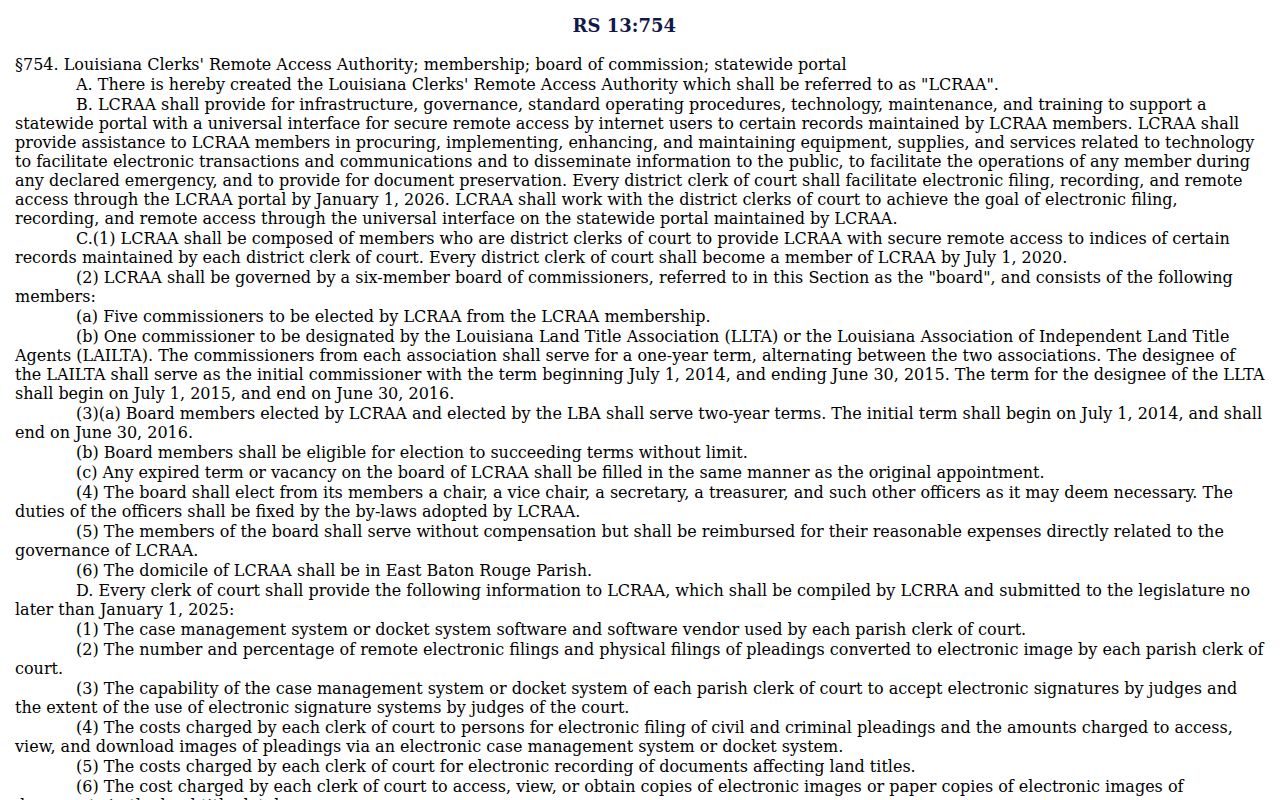
It does not turn the listed clerk components into a complete succession quote or guarantee free historical images.
What Louisiana Succession Records Show
A result may identify the suit number, “Succession of” caption, decedent, domicile, filing date, testate or intestate status, judge, division, petitioner, representative, and counsel. Docket events may show the testament filing, order of probate, appointment, letters, bond, creditor notices, claims, sales, accounts, tableau of distribution, homologation, judgment of possession, appeal, costs, and closure.
| Document | What It Establishes |
|---|---|
| Petition and jurisdiction affidavits | Death facts, domicile, requested relief, and proposed successors or representative |
| Testament and probate order | Will terms and court action accepting it for the succession |
| Letters | Current authority of an executor or administrator |
| Inventory or descriptive list | Estate property and values when publicly available |
| Judgment of possession | Successors and property placed in possession |
| Recorded conveyance instrument | Effect on third parties and immovable-property title records |
Opening a succession does not transfer every asset. Letters show representative authority; the judgment of possession identifies distribution. For property proof, request a certified judgment and the recorder-certified conveyance instrument when applicable.
Restricted Louisiana Succession Records
Medical evidence, financial identifiers, minors' information, and sealed inventories may be withheld or redacted. Article 253 requires protected identifiers to be omitted from covered filings and preserves special handling for certain paper originals. The official Louisiana filing rule is especially relevant to original testaments and electronic court records.
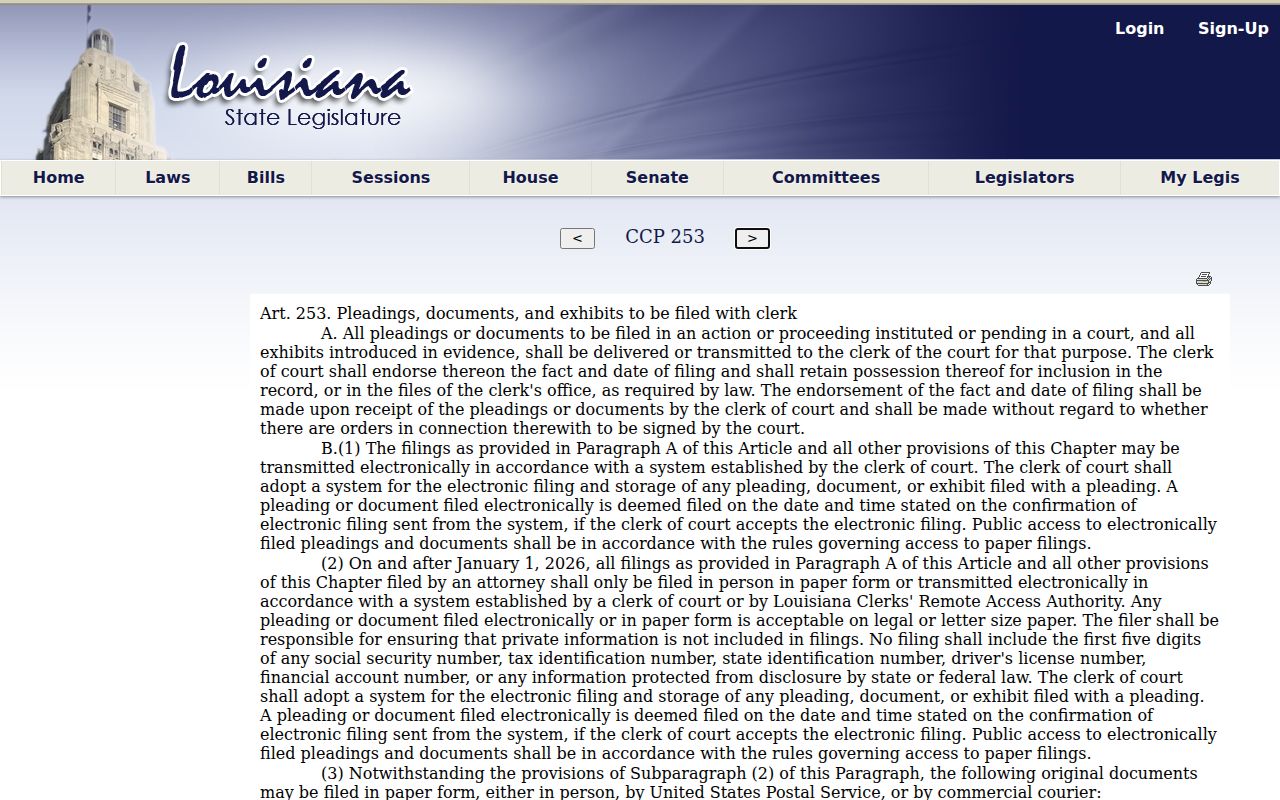
Electronic access follows the public status of the court file. It does not override a seal, privacy rule, or original-document requirement.
Louisiana Tutorship and Interdiction
Tutorship protects a minor through court supervision and can include an undertutor, inventory, bond, account, and authority for specified acts. Interdiction requires proof and due process before an adult's capacity is restricted. A curator or undercurator may then file reports and accounts. These matters may appear in a succession-related index or a separate parish category.
Health and financial evidence can be strongly protected. A public docket entry does not mean every evaluation or exhibit is open. Request the precise public order or filing needed, and expect the clerk to require a court order for restricted material.
Louisiana Parish Succession Access
The Louisiana Clerks of Court directory identifies the parish custodian when portal coverage is incomplete.
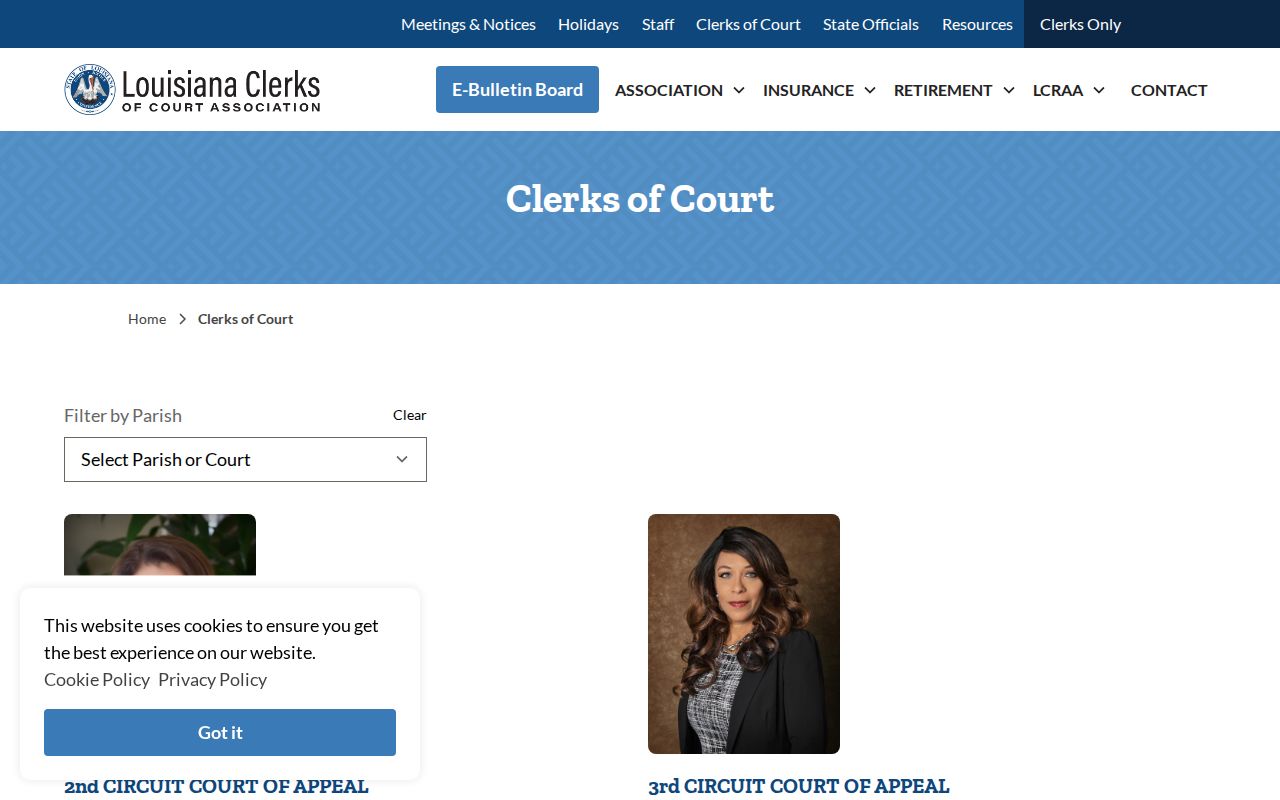
Use it to reach the succession department for counter inspection, mail requests, archive retrieval, certified copies, and current fee estimates.
Find Louisiana District Court Successions
Use the directory of all 64 Louisiana parishes to reach the District Court clerk's succession department. Provide the decedent's name, date of death, domicile, approximate filing year, known suit number, and exact documents requested. Orleans succession matters go to Civil District Court.
Search conveyance records as well when inherited immovable property is the goal. A small-succession affidavit can be recorded in qualifying circumstances without the conventional suit a researcher expects. Ask for the testament, order of probate, letters, public inventory or descriptive list, judgment of possession, and recorded conveyance reference as needed. Note: A failed statewide name search does not prove that no Louisiana succession exists.